
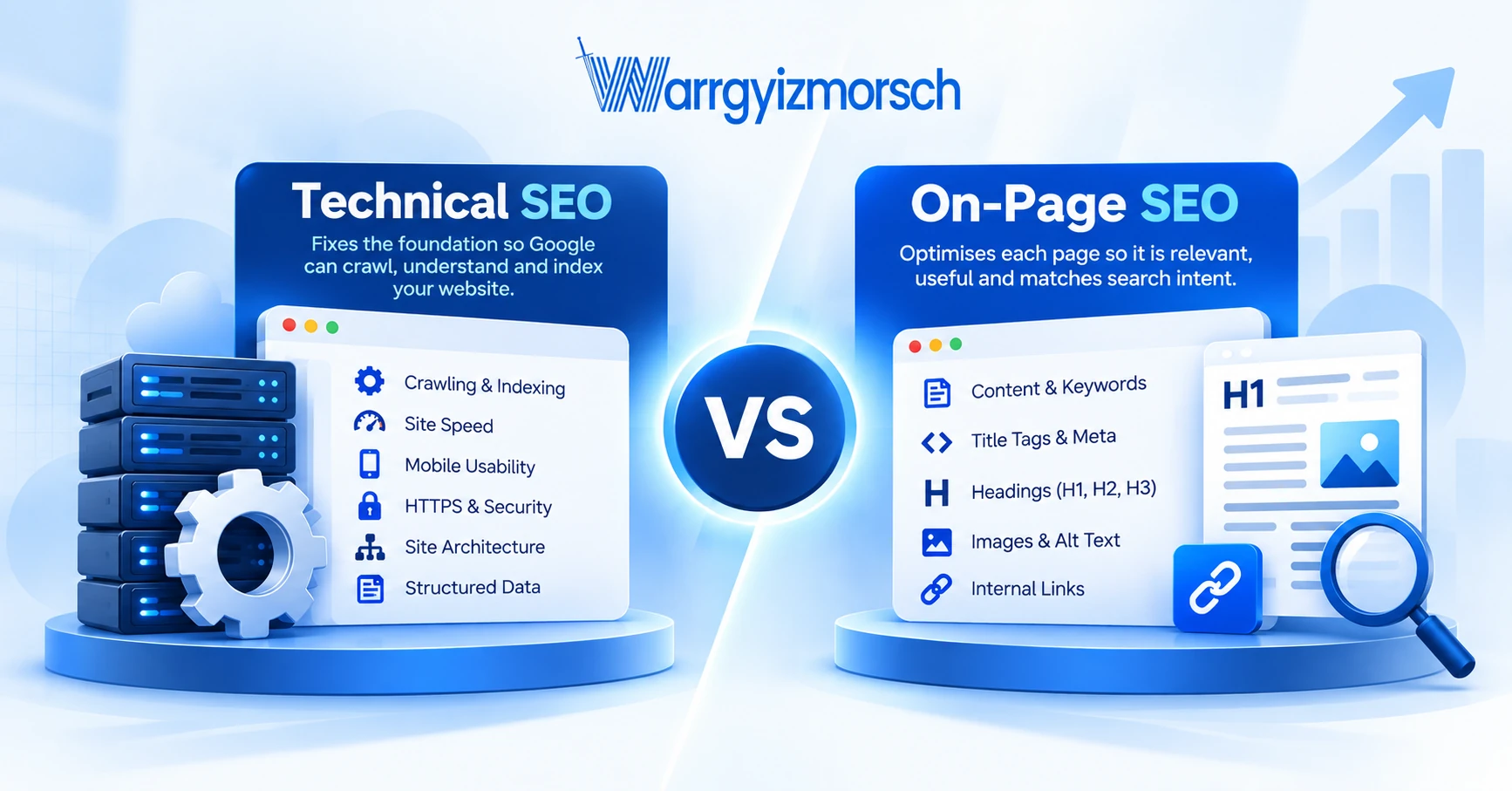
Technical SEO vs on page SEO is not a fight where one has to win. In fact, both need to work together if you want better search rankings.
Think of technical SEO as the foundation of your website. It helps search engines like Google and bing to find, crawl and index your pages properly. On page SEO is what you build on that foundation. It focuses on your content, headings, keywords, internal links and how well each page answers what people are searching for.
Here is an easy way to look at it: great content won’t help much if Google struggles to find or index it. At the same time, a technically strong website won’t magically rank if its content does not give users the answers they need.
So, which one should you focus on? Usually, both. Whether your business operates in India or any other country, technical SEO and on-page SEO need to work together to give your website a stronger chance of ranking well on Google.
In this guide, we will break down technical SEO vs on page SEO, explain the key differences and help you understand which one can have a bigger impact on your rankings.
What Is Technical SEO?
Technical SEO is about making sure your website works properly for both search engines and users. It helps Google and other search engine to crawl, understand and index your pages while also giving visitors a fast, secure and smooth experience.
Think of it as the foundation of a house. You may not notice it when everything works, but when something breaks, the whole experience suffers.
Technical SEO mainly includes:
- Crawlability:Helping Google easily discover important pages.
- Indexability:Making sure the right pages can appear in search results.
- Website speed:Helping pages load quickly so users do not leave waiting.
- Mobile-friendliness:Making your website work smoothly across different screen sizes.
- HTTPS security:Keeping your website and visitors secure.
- Structured data:Helping search engines better understand your content.
- Site architecture:Organising pages so users and search engines can easily navigate your website.
Example: Imagine an online furniture store with 3,000 products. If every colour, size or price filter creates a new URL, Google may find thousands of similar pages. If those filters are also slow on mobile, users may have a poor shopping experience.
Fixing the URLs, site structure, speed and mobile experience is technical SEO because it makes the website better for both Google and users.
What Is On-Page SEO?
On page SEO is about improving individual web pages so Google can understand the content and users can easily find the answers they are looking for.
If technical SEO asks, “Can Google find and access this page?”, on-page SEO asks, “Is this page useful and relevant to the search?”
On-page SEO mainly includes:
- Search intent:Understanding what users actually want when they search.
- Keywords:Using your main keyword and related terms naturally in the content.
- Title and headings:Creating clear titles, H1s, H2s and H3s that explain the page.
- Content quality:Providing useful information, examples and clear answers instead of writing only for keywords.
- Meta description:Giving searchers a clear reason to click your result.
- Internal links:Connecting users to other useful and relevant pages.
- Images and alt text:Using relevant images and describing them properly.
- URL structure:Keeping URLs short, clear and relevant.
Imagine a CA firm targeting “GST registration in Pune.” Google can crawl and index its page, but the content is too short and does not properly answer what users want to know.
Adding a better title, registration steps, required documents, fees, timelines, FAQs and useful internal links can make the page much more helpful.
That is on-page SEO: making each page more relevant and useful for both users and search engines.
Technical SEO vs On-Page SEO: Key Differences
Now that we know what both mean, here is a simple comparison of technical SEO vs on page SEO:
|
Factor |
Technical SEO |
On-Page SEO |
|
Main focus |
Website performance and technical setup |
Content and individual pages |
|
Main question |
Can Google easily crawl and index the website? |
Does this page properly answer the search? |
|
Scope |
Mostly site-wide |
Page by page |
|
For users |
Improves speed, security and mobile experience |
Improves content, readability and relevance |
|
Key areas |
Crawling, indexing, speed, mobile, redirects, schema |
Content, keywords, titles, headings, images, internal links |
|
Common problems |
Slow pages, indexing issues, broken links, duplicate URLs |
Thin content, wrong search intent, weak titles, poor internal linking |
|
Main tools |
Search Console, PageSpeed Insights, Screaming Frog |
Search Console, keyword and content tools |
|
Success indicators |
Better crawlability, indexing and site performance |
Better visibility, clicks, engagement and conversions |
Technical SEO makes sure your website works properly and can be accessed by search engines, while on-page SEO makes sure your pages provide useful and relevant answers to users.
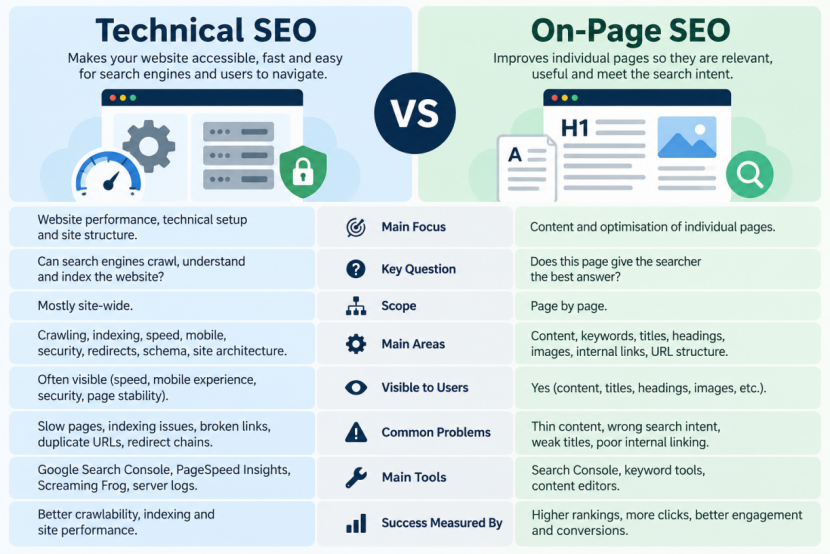
You need both because a technically strong website with poor content can struggle to rank, just as great content can struggle when the website has serious technical problems.
Which Is More Important: Technical SEO or On-Page SEO?
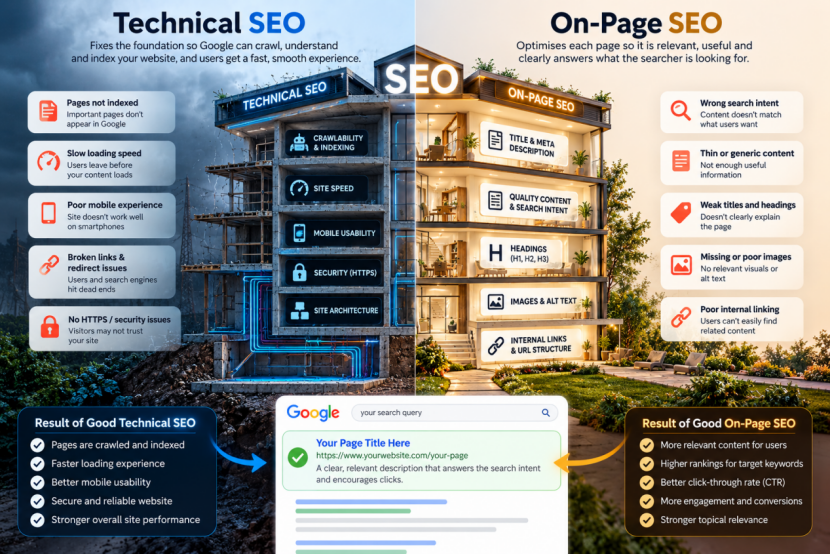
In short, both matter, but for different reasons. Technical SEO removes problems that can stop Google from properly accessing and indexing your pages. On-page SEO makes those pages useful, relevant and worth showing to searchers.
Think of it this way: technical SEO gets your page into the race, while on-page SEO helps it compete.
If your page cannot be crawled or indexed, even great content may struggle to appear in search results. But if your website is technically perfect and the content does not answer what users are searching for, strong rankings can still be difficult.
So, instead of asking which one is better, ask: Which one does my website need more right now?
When Should You Focus on Technical SEO?
Technical SEO should usually come first when:
- Important pages are not being indexed.
- Your website is slow or performs poorly on mobile.
- You have lots of broken links, redirects or duplicate URLs.
- You recently redesigned or migrated your website.
- Search visibility suddenly drops across many pages.
When Should You Focus on On-Page SEO?
On-page SEO should usually be the priority when:
- Your pages are indexed but still rank poorly.
- Your content does not properly match search intent.
- Titles and headings are weak or unclear.
- Important pages have thin or outdated content.
- Your pages get impressions but very few clicks.
Fix serious technical problems first. Once Google can properly access and index your pages, focus on creating useful, relevant content that gives users the answers they came for.
Use Google Search Console to Find What Needs Fixing
Instead of guessing what is holding your website back, use Google Search Console to find the problem. It can show whether your pages have indexing issues or whether they are appearing in search but need better optimization.
Here is a simple way to read the signals:
|
What You See |
Where to Check |
What It Could Mean |
Focus On |
|
Important pages missing from Google |
Indexing → Pages / URL Inspection |
Indexing, canonical, or crawl issue |
Technical SEO |
|
URLs discovered but not indexed |
Indexing → Pages |
Crawl priority, internal linking, or page-value issues |
Technical + On-page |
|
URLs crawled but not indexed |
Indexing → Pages |
Content quality, duplication, or other indexing issues |
Investigate both |
|
Poor Core Web Vitals |
Core Web Vitals |
Performance or page-experience issues |
Technical SEO |
|
High impressions but weak positions |
Performance |
Page may need stronger relevance or content |
On-page SEO |
|
Good rankings but low CTR |
Performance |
Search snippet may not attract enough clicks |
On-page SEO |
|
Traffic drops after a site migration |
Performance + Indexing |
Redirect, URL, canonical, or indexing problems |
Technical SEO |
SEO Tip: Search Console tells you where to investigate, not always the exact cause. Use its data as a starting point before making changes.
A Simple SEO Action Plan
Once you identify the problem, follow this order:
Choose your priority pages: Start with the service, product, category or location pages that matter most to your business.
Inspect important URLs: Use URL Inspection to check their indexing status and Google-selected canonical.
Resolve critical technical issues: Fix problems that prevent important pages from being accessed or indexed correctly.
Review search performance: Find queries bringing impressions to your priority pages and see where opportunities exist.
Improve pages with potential: Strengthen content around search intent, useful information, titles, headings, and relevant internal links.
Measure the impact: Track clicks, impressions, CTR, and search visibility after making meaningful changes.
The goal is simple: use technical SEO to keep your website healthy and on-page SEO to make your important pages more useful and competitive. Search Console helps you see where your attention is needed first.
Common Technical and On-Page SEO Mistakes
Even a good SEO strategy can lose effectiveness because of a few avoidable mistakes. Here are some worth watching for:
Technical SEO Mistakes
- Accidentally blocking indexing:Leaving noindex settings active after launching or redesigning a website.
- Indexing test pages:Allowing staging, development or duplicate versions of the website to appear in Google.
- Poor redirect setup:Creating unnecessary redirect chains when URLs or domains change.
- Overloading pages:Adding too many scripts, pop-ups, trackers or widgets that affect performance.
- Focusing only on scores:Chasing a perfect PageSpeed score instead of improving the actual experience visitors receive.
On-Page SEO Mistakes
- Keyword stuffing:Repeating the same keyword unnaturally throughout the content.
- Duplicate location pages:Creating multiple city pages with almost identical content.
- Copied content:Reusing manufacturer or competitor descriptions instead of adding original value.
- Duplicate title tags:Using the same or very similar titles across multiple important pages.
- Ignoring search intent:Creating a blog post when users are clearly looking for a product, service, or another type of page.
Avoiding these mistakes helps create a website that is easier for search engines to understand and more useful for the people visiting it.
Conclusion
The technical SEO vs on page SEO debate is not really about choosing one over the other. Both solve different problems and both are needed for long-term SEO growth.
Technical SEO creates a strong foundation by helping search engines access and understand your website while keeping it fast and user-friendly. On-page SEO builds on that foundation with useful content that matches what people are actually searching for.
The best approach is simple: keep your website technically healthy and continuously improve the pages that matter most to your audience and business.
SEO works best when these two areas support each other. A technically sound website makes great content easier to discover, while strong on-page SEO gives that visibility a reason to turn into clicks, engagement and conversions.
If you are unsure what is limiting your website's growth, an SEO audit can help identify where the biggest opportunities are before you invest time and budget in the wrong areas.
Frequently Asked Questions
Ali Asgar Bhalam
Engineering, Cloud & Digital Solutions Group
Delivering modern, scalable, high-impact digital experiences across web, apps, AI, and enterprise software.